“We Need More Leads” Is the Most Dangerous Sentence in Marketing
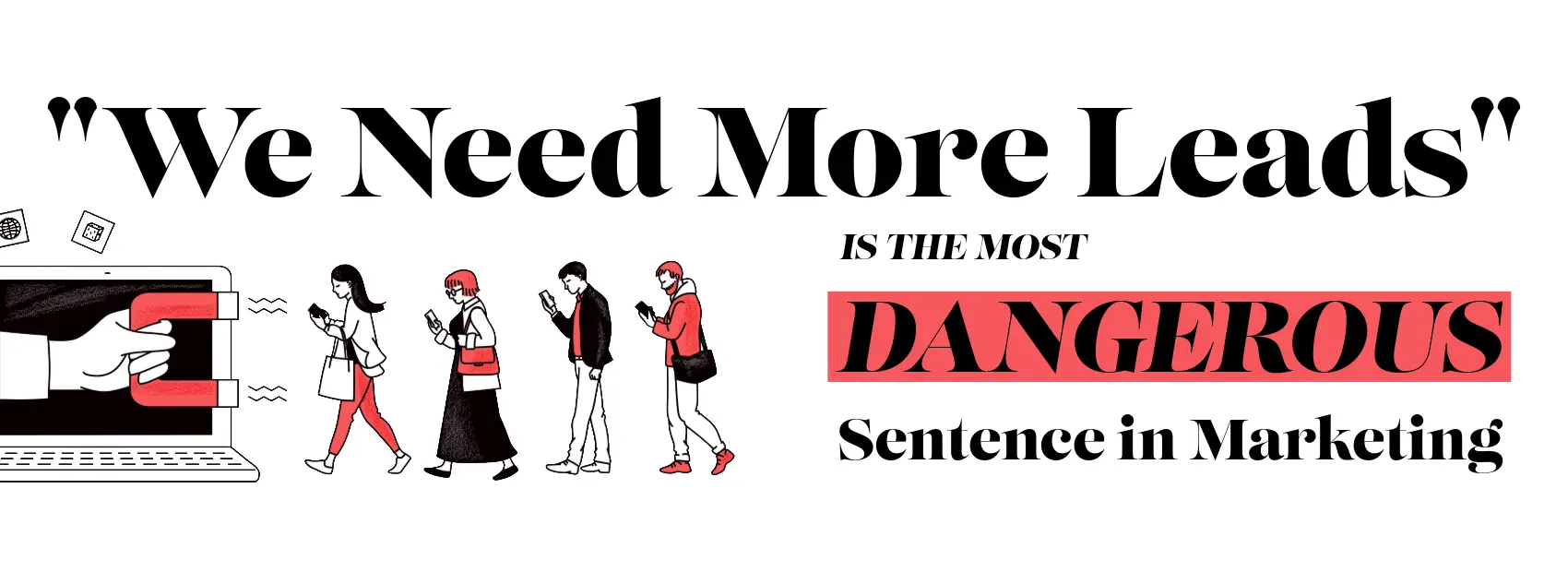
“We need more leads.”
It sounds logical. It feels urgent. It is also one of the most dangerous sentences in marketing.
Because most of the time, it is not true.
When a leadership team says we need more leads, they are really saying that something is not converting, resonating, or aligned. However, instead of digging into the root cause, the instinct is to push for more volume.
More campaigns. More ads. More content. More noise.
And that is where things start to go sideways.
The Illusion of More
More leads create the appearance of progress.
Dashboards look better. Reports feel stronger. Activity increases across marketing and sales. However, if those leads are not the right fit, nothing meaningful changes.
Sales still struggle to convert.
Deals still stall.
Revenue still lags expectations.
Now the conversation shifts again.
“We need better leads.”
At that point, you are not solving a problem. You are chasing symptoms.
According to HubSpot, many organizations generate leads that never convert into meaningful opportunities because targeting and messaging are misaligned. The issue is not volume. It is relevant.
Where the Breakdown Actually Happens
The problem rarely starts with lead generation. It starts much earlier.
It starts with who you are trying to reach.
If your Ideal Client Profile is too broad, your messaging becomes diluted. You try to appeal to too many industries, personas, and use cases. As a result, your content feels generic.
Generic content attracts generic leads.
And generic leads rarely convert.
So when leadership says we need more leads, they are often feeding the very problem they are trying to solve.
Because more of the wrong things are still the wrong things.
Why More Leads Actually Slow You Down
This is the part most teams do not see right away.
More leads do not just fail to help. They can actively hurt your performance.
Sales teams spend time qualifying poor-fit prospects.
Pipelines become inflated with low-probability opportunities.
Forecasting becomes unreliable.
Confidence across the organization starts to erode.
Instead of moving faster, everything slows down.
And now you are not just dealing with a marketing issue. You are dealing with an operational issue.
Firms like McKinsey & Company have noted that inefficient pipeline management often stems from poor lead quality, not from a lack of volume. When the wrong opportunities enter the system, everything downstream suffers.
What High-Performing Marketing Actually Focuses On
Strong marketing does not chase volume. It focuses on alignment.
It starts by getting clear on who you serve and who you do not. It defines the problems that matter most to that audience. It builds messaging that speaks directly to those problems in an easy-to-understand way.
When that alignment is in place, something interesting happens.
You may generate fewer leads.
But you generate better leads.
Leads that:
- understand your value.
- see themselves in your messaging.
- move faster through the pipeline.
That is when marketing starts to feel different.
Instead of feeding sales activity, it fuels sales momentum.
The Role of Messaging in Conversion
Even with the right audience, messaging plays a critical role.
If your messaging is unclear, overly technical, or too internally focused, it creates friction. The buyer has to work to understand what you do. That effort introduces hesitation.
And hesitation kills conversion.
When your message is clear, the opposite happens.
The buyer immediately understands the problem you solve.
They see the outcome.
They recognize the value.
At that point, the conversation changes.
You are no longer trying to convince. You are aligning.
And that is where deals start to move.
Why This Matters More in an AI-Driven World
The shift toward AI-driven search and decision-making is amplifying this problem.
Buyers are asking direct questions and expecting precise answers. They are not sifting through pages of content. They are looking for clarity in seconds.
If your message is broad or vague, you will not show up in those moments.
Organizations like Gartner continue to emphasize that buyers expect relevance and personalization early in the journey. That expectation is only increasing as technology evolves.
So when teams say we need more leads, they are often ignoring the reality that visibility today depends on clarity, not volume.
A Better Question to Ask
Instead of asking for more leads, ask a different question.
Are we attracting the right leads?
That one shift changes everything.
It forces you to:
- look at your ICP.
- evaluate your messaging.
- analyze your conversion points.
It moves the conversation from activity to effectiveness.
Because the goal is not more leads.
The goal is more of the right opportunities.
The Real Outcome You Should Be Driving
When marketing is aligned, the pipeline looks different.
It is:
- smaller, but stronger.
- more predictable.
- easier to manage.
Sales conversations improve because prospects already understand your value. Sales cycles shorten because there is less friction. Close rates increase because you are speaking to the right audience with the right message.
That is how growth happens.
Not through volume.
Through alignment.
Fix the Right Problem
If your organization keeps coming back to “we need more leads,” it is worth stepping back and looking at what is really happening.
At Equilibrium Consulting, we focus on getting the foundation right first. That means defining the Ideal Client Profile, tightening messaging, and aligning the buyer journey before scaling campaigns.
Because when you fix the right problem, you do not need more leads.
You need better ones.
FAQ
Q: Why do more leads not always improve revenue?
A: Because if the leads are not the right fit, they will not convert into meaningful opportunities.
Q: How can I improve lead quality?
A: Start by refining your Ideal Client Profile and aligning your messaging to that audience.
Q: Is lead generation still important?
A: Yes, but only after you have clarity on who you are targeting and how you communicate value.
Q: What is the biggest mistake companies make with leads?
A: Focusing on volume instead of relevance and alignment.
Q: How do I know if my leads are the wrong fit?
A: Look at conversion rates, sales cycle length, and how often deals stall or go cold.
About the Author: Equilibrium Consulting

Share This Story, Choose Your Platform!
Related Posts