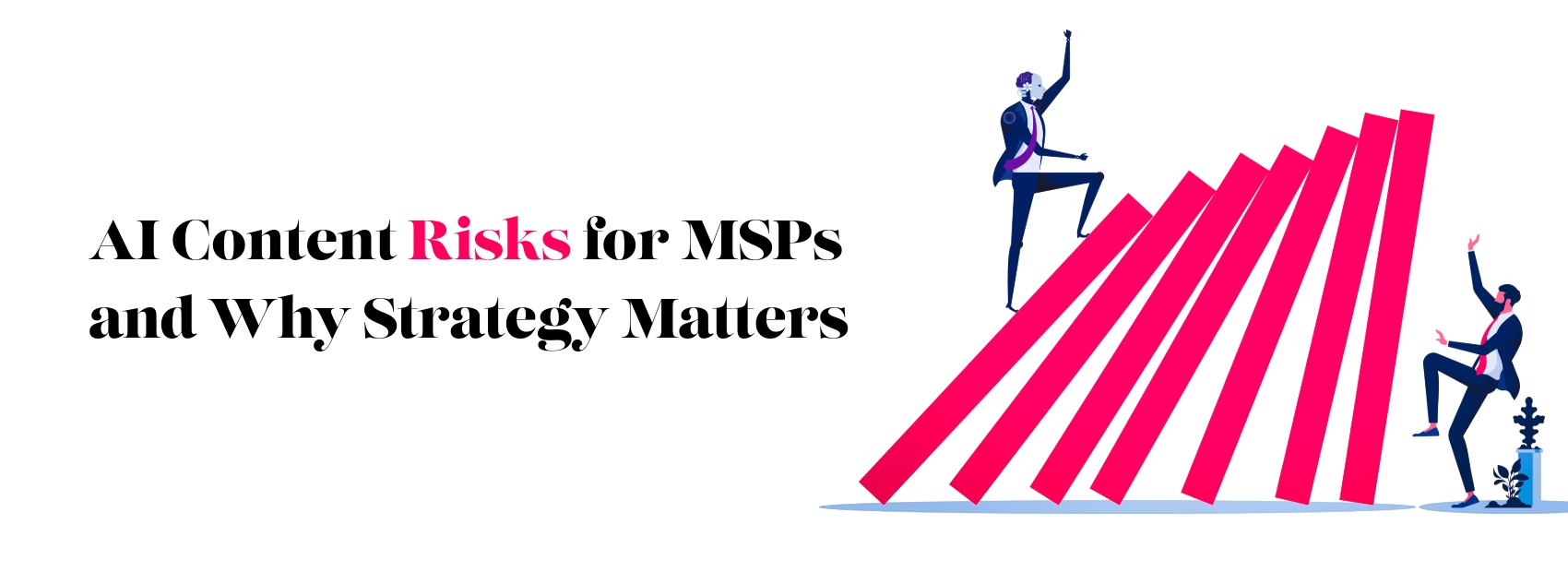
AI Content Risks for MSPs and Why Strategy Matters
AI content risks for MSPs are becoming a real concern as more IT providers attempt to automate their marketing entirely. The promise sounds attractive. Faster blogs. Instant social media. Automated emails. Unlimited website content.
Unfortunately, many MSPs are discovering that speed does not always equal results.
In fact, some organizations are now seeing declining engagement, weaker rankings, poor lead quality, and content that sounds almost identical to their competitors.
The reason is simple.
AI can generate content quickly, but it cannot replace strategic marketing leadership.
At Equilibrium Consulting, we believe AI should support marketing, not control it. There is a major difference between AI-assisted marketing and AI-dependent marketing.
That distinction matters more now than ever.
Search Engines Are Evolving Beyond Keywords
Years ago, SEO focused heavily on keywords and technical optimization. Today, the environment is dramatically different.
Modern search engines evaluate:
- Content quality
- User behavior
- Topical authority
- Authenticity
- Expertise
- Trust signals
- Contextual relevance
Additionally, AI-powered search experiences now summarize information directly within search results.
That means low-value content has less opportunity to perform.
Search engines want to deliver helpful, trustworthy answers. If your content lacks originality or meaningful expertise, achieving visibility becomes harder.
This is especially important for MSPs competing in crowded regional markets.
AI Detection Is Becoming More Sophisticated
Many business owners still assume AI-generated content is impossible to detect. That assumption is dangerous.
Detection systems are improving rapidly.
Platforms analyze:
- Sentence structure patterns
- Repetitive phrasing
- Predictable transitions
- Lack of unique insights
- Thin topical depth
- Generic formatting
- Semantic repetition
Even if detection is not perfect, quality evaluation absolutely is. Content that feels robotic usually performs poorly with human readers, too. That creates a double problem. Search engines may distrust the content, and buyers may disengage from it.
Neither outcome helps pipeline growth.
Generic Content Damages Authority
One of the biggest mistakes MSPs make with AI is publishing content simply to maintain volume.
Unfortunately, publishing weak content repeatedly can hurt long-term authority.
Think about it this way.
If your website contains:
- Generic blogs
- Recycled insights
- Thin educational content
- Minimal expertise
- No local relevance
- Weak buyer alignment
Then your overall domain quality may weaken over time.
This becomes especially problematic for AEO.
AI search systems increasingly prioritize authoritative sources that demonstrate genuine expertise and real-world experience.
That means firms that rely heavily on mass AI-generated content may eventually lose visibility to organizations producing fewer but higher-quality assets.
Your Buyers Want Expertise, Not Automation
Most MSP buyers are not looking for perfectly optimized paragraphs.
They are looking for confidence.
They want to know:
- Can you solve their problems?
- Do you understand their industry?
- Have you handled similar challenges?
- Will your team support them properly?
- Can you explain complex topics clearly?
Those trust factors are difficult for AI alone to communicate authentically.
Strong marketing requires emotional understanding, storytelling, positioning, and operational knowledge.
That comes from people.
Why AI Alone Creates Brand Problems
Another overlooked issue involves brand consistency.
AI tools often produce content that changes tone, messaging style, structure, and positioning from piece to piece.
Over time, brands become fragmented.
One blog sounds corporate. Another sounds technical. Another sounds overly casual. Another sounds like every other MSP online.
Consistency matters because buyers form perceptions quickly.
Strong agencies protect brand voice intentionally.
At Equilibrium Consulting, we help MSPs develop consistent messaging frameworks tied directly to:
- ICPs
- Personas
- Buyer journeys
- Service priorities
- Vertical markets
- Geographic positioning
- Operational strengths
That strategic alignment keeps marketing cohesive across all channels.
AI Cannot Replace Strategic Oversight
Marketing is more than producing assets.
Successful marketing requires:
- Planning
- Coordination
- Optimization
- Attribution
- Technical SEO
- AEO structure
- Internal linking
- Campaign alignment
- Funnel development
- Conversion analysis
AI cannot manage all those moving parts independently.
Without oversight, many MSPs create disconnected marketing ecosystems filled with random blogs, inconsistent messaging, and weak conversion paths.
That is not a growth strategy. That is content chaos.
The Best Agencies Use AI Responsibly
The smartest agencies are not avoiding AI.
They are mastering it responsibly.
That means using AI for:
- Workflow acceleration
- Content ideation
- Research assistance
- Outline creation
- Repurposing support
- Optimization guidance
However, humans still lead:
- Strategy
- Positioning
- Editorial oversight
- SEO direction
- AEO structure
- Brand voice
- Buyer alignment
That hybrid approach delivers better outcomes by combining efficiency with expertise.
The Real Competitive Advantage
Ironically, AI may increase the value of authentic human expertise over time.
As more organizations flood the internet with generic content, buyers will increasingly gravitate toward firms demonstrating:
- Real experience
- Clear differentiation
- Community involvement
- Operational knowledge
- Thought leadership
- Authentic perspective
Those are competitive advantages AI cannot replicate on its own.
That is why strategic agencies still matter.
Final Thoughts
AI content risks for MSPs are no longer theoretical. They are already impacting visibility, authority, and trust.
The goal should not be avoiding AI. The goal should be to use AI intelligently.
Organizations that combine human strategy with AI efficiency will outperform firms relying entirely on automation.
That balance creates stronger SEO, better AEO performance, higher trust, and ultimately more pipeline.
Technology may accelerate marketing. However, strategy still determines whether marketing works.
About the Author: Equilibrium Consulting

Share This Story, Choose Your Platform!
Related Posts