Your Next Sales Meeting May Happen Without You
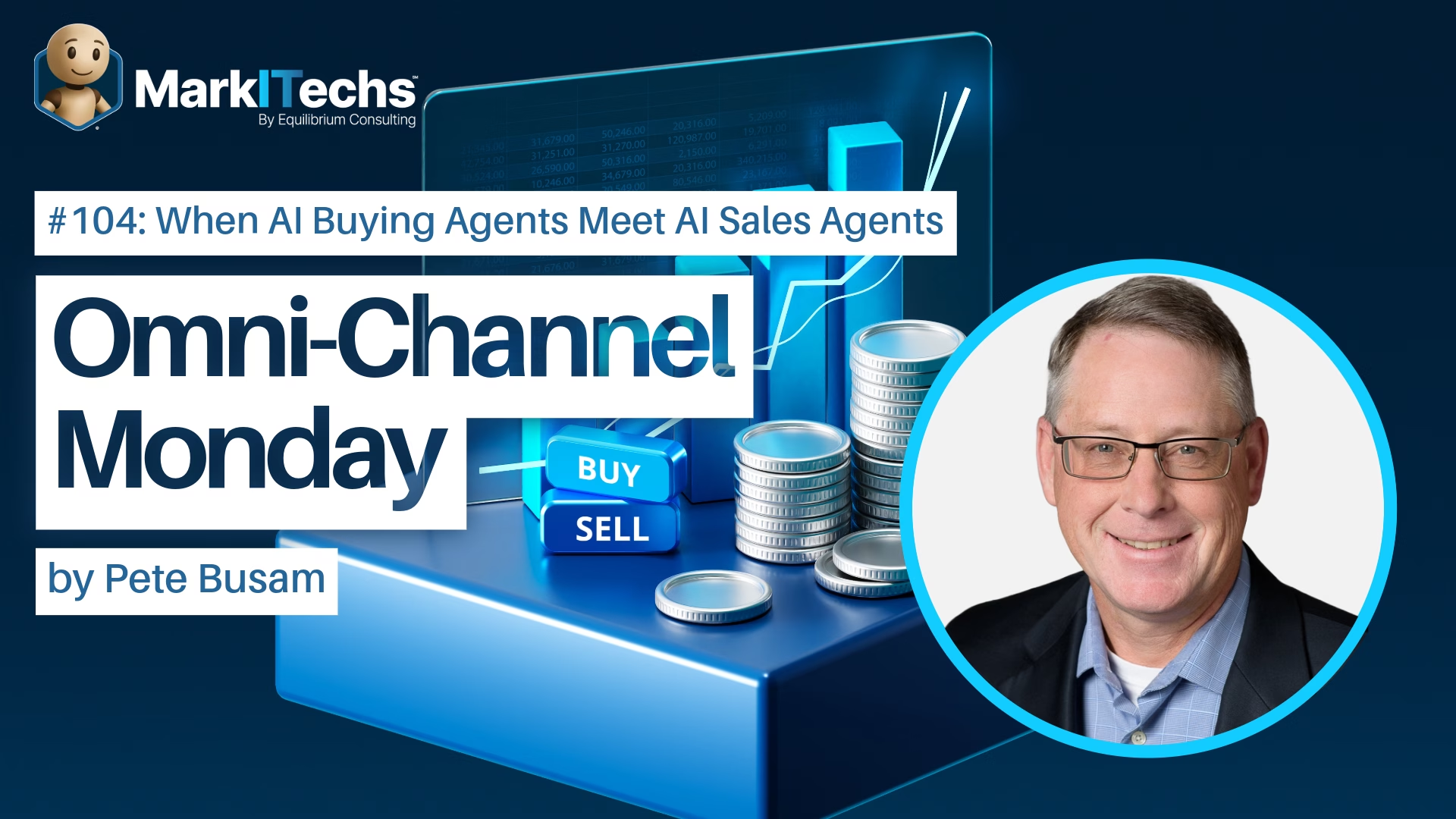
When AI Buying Agents Meet AI Sales Agents
First, we asked whether your next prospect might be an AI agent.
Next, we explored how your next salesperson might also be an AI sales agent.
Now, we need to consider what happens when those two agents meet.
A buyer’s AI agent may research providers, compare services, evaluate evidence, and recommend a shortlist. Meanwhile, a company’s AI sales agent may answer questions, qualify the opportunity, and suggest next steps.
That means the first meaningful sales conversation could happen without either human in the room.
For MSPs, cybersecurity companies, SaaS providers, and technology vendors, this changes the buyer journey again.
Your AI sales agent may need to convince another AI agent that your company deserves human consideration.
AI Sales Agents Are Entering Both Sides of the Buyer Journey
Most sales processes still assume a person visits a website.
The visitor reads several pages, downloads content, completes a form, and waits for a response. Sales then begins asking questions to determine whether the opportunity fits.
However, an AI buying agent could complete much of that work independently.
A business leader might instruct an agent:
“Find three MSPs that support architectural firms with 75 to 200 employees. They must offer co-managed IT and understand cybersecurity compliance.”
The buying agent could search websites, review case studies, compare services, and examine third-party reviews.
Meanwhile, an MSP’s AI sales agent could respond to questions about qualifications, service areas, experience, and customer fit.
The two systems might exchange information before either human becomes involved.
This is no longer purely theoretical. Salesforce surveyed 4,050 sales professionals for its 2026 State of Sales report. Nine in ten sales teams use AI agents or expect to use them within two years.
As a result, AI sales agents are becoming part of modern sales infrastructure.
What Would AI Agents Discuss?
An AI-to-AI sales interaction would probably begin with facts.
The buying agent might ask:
- Which industries does the MSP serve?
- What company sizes represent its ideal customer?
- Where does the MSP provide service?
- Does it offer managed and co-managed IT?
- What cybersecurity standards does it support?
- Can it provide relevant customer outcomes?
- How does its pricing model work?
- What happens during onboarding?
- Which certifications, partnerships, or reviews support its claims?
The sales agent needs accurate, approved answers.
Those answers must also match the company’s website, directories, case studies, and other digital sources.
If they don’t, the buying agent may flag a credibility problem.
A human prospect might overlook one outdated directory. An AI agent may compare several sources within seconds.
Your Website Becomes Evidence, Not Just Marketing
Many MSP websites rely on broad statements.
They promise proactive support, better security, strategic guidance, and responsive service. However, nearly every competitor makes similar claims.
Those statements may sound good to a person. Still, they provide little evidence for an AI agent evaluating fit.
An AI-ready website needs greater clarity.
For example, “We provide strategic IT solutions” is difficult to evaluate.
A stronger explanation might state:
“We provide managed and co-managed IT services for 50-to-250-person professional services firms across the Carolinas.”
The second statement gives the agent specific facts.
It identifies the service, customer size, industry, and geography. That way, the agent can compare it with the buyer’s requirements.
This is where MSP marketing strategy, SEO, and answer engine optimization begin working together.
Your ICP Becomes a Machine-Readable Qualification Standard
Your ideal customer profile can no longer remain inside a forgotten planning document.
It must guide your content, sales process, CRM, and AI sales agents.
A clear ICP should define:
- Industries and company sizes
- Service geography
- Technology requirements
- Internal IT capabilities
- Compliance concerns
- Common buying triggers
- Budget expectations
- Poor-fit characteristics
The buying agent uses similar information from the opposite direction.
It knows the buyer’s size, industry, location, needs, priorities, and possible restrictions. It may then compare those requirements with your published qualifications.
When both sides provide clear information, the agents can identify alignment quickly.
However, vague positioning creates vague recommendations.
If your MSP claims to serve everyone, an agent may struggle to determine whom you serve best.
Evidence Could Decide Who Reaches the Shortlist
AI buying agents will not simply evaluate what companies say about themselves.
They may also examine whether outside sources support those claims.
That evidence could include:
- Customer reviews
- Detailed case studies
- Partner directories
- Industry certifications
- Leadership experience
- Association memberships
- Media coverage
- Consistent business profiles
- Educational articles
- Documented customer outcomes
Consider two MSPs with similar services.
The first MSP claims to understand manufacturing. However, its website offers no manufacturing case study or industry-specific content.
The second MSP has a manufacturing service page, customer story, relevant reviews, and partner recognition.
Which company gives the buying agent more evidence?
The second MSP does not automatically win. However, it becomes easier to understand, validate, and recommend.
That is the foundation of a strong AI buyer journey.
Conflicting Information Could Eliminate You
AI sales agents are only as reliable as the information they have.
According to Salesforce, 46% of sales professionals using agents say data-quality problems hurt sales. Manual errors, duplicate records, security concerns, and incomplete data remain common barriers.
Now apply that problem to your entire digital footprint.
Your:
- website says you specialize in professional services. Yet an old directory says you provide residential computer repair.
- service page promises nationwide support. However, your FAQ describes a limited regional area.
- AI sales agent quotes one qualification requirement. Meanwhile, your human salesperson uses another.
Which answer should a buying agent trust?
Consistency will become part of credibility.
Therefore, MSPs must review what their websites, CRM platforms, sales materials, profiles, and agents say about them.
Automation does not hide weak positioning. It exposes inconsistencies faster.
The Human Handoff Becomes More Important
AI agents should not remove people from relationship-driven sales.
Instead, they should determine when a human conversation will create the most value.
An AI sales agent can answer common questions. It can also collect information, assess fit, and recommend relevant resources.
However, it should not control every discussion.
Humans remain essential when a buyer needs judgment, empathy, negotiation, or reassurance. They also matter when internal politics or business risks influence the decision.
The agent should recognize those moments.
A good handoff should provide the salesperson with:
- The buyer’s organization and persona
- Business needs and buying triggers
- Questions already asked
- Content already reviewed
- Identified concerns
- Stakeholders involved
- Recommended next steps
As a result, the salesperson avoids repeating the entire discovery process.
The human conversation can begin where the automated one ended.
Five Steps Toward an AI-Ready Sales Process
MSPs do not need to deploy advanced AI sales agents tomorrow. However, they should prepare the foundation today.
- Document Your ICP
Define the customers you serve best. Include company size, industries, geography, technology needs, and buying triggers.
- Map Personas and Buyer Journeys
Identify who participates in the decision. Then document the questions each person asks during every stage.
- Strengthen Your Website Content
Explain who each service supports, which problems it solves, how it works, and what evidence validates it.
- Align Your Digital Footprint
Review directories, social profiles, review platforms, partner listings, and other third-party sources. Correct outdated or conflicting information.
- Establish Human Escalation Points
Decide when the agent must involve a person. Pricing exceptions, security concerns, complex environments, and sensitive business issues deserve human attention.
The Sale May Start Before You Know It
The future sales meeting may not begin on Zoom, Teams, or a telephone call.
It may begin when a buyer instructs an AI agent to find the right provider.
That agent may encounter your content, digital reputation, and AI sales agent before you see a form submission.
By the time a human reaches your sales team, several competitors may already be gone.
The companies that succeed will not simply install more automation. They will develop clearer positioning, stronger evidence, consistent information, and better handoffs.
Machine discovery gets you considered.
Machine-to-machine validation may get you shortlisted.
Human trust still gets you chosen.
The question is no longer whether AI will enter the sales conversation.
The question is whether your MSP marketing strategy will give it the right conversation to have.
Is Your Business Ready for an AI Buyer?
Use Equilibrium Consulting’s AI Reality Check to examine what AI may understand about your company.
It’s free to use, and your information isn’t sent to Equilibrium.
Then ask one important question:
If your buyer’s AI agent met your AI sales agent today, would they agree that your company is the right fit?
Frequently Asked Questions
What is an AI buying agent?
An AI buying agent helps a person or organization research and compare potential solutions. It may search for providers, evaluate requirements, review evidence, and recommend a shortlist. More advanced agents may also ask vendors questions or complete approved actions. The human buyer still establishes the goals, restrictions, and final decision authority.
Can AI sales agents communicate with AI buying agents?
AI agents can already exchange information through websites, applications, databases, and software integrations. However, fully autonomous B2B negotiations are still developing. The more immediate opportunity is for agents to gather information, answer approved questions, evaluate fit, and prepare both parties for a human conversation.
How should an MSP prepare for AI-driven buyers?
Begin with a clear ICP, detailed personas, and a documented buyer journey. Then strengthen service pages, case studies, FAQs, and third-party profiles. Keep information specific, consistent, and evidence-based. Finally, establish rules for qualification, privacy, data access, and human escalation.
Will AI agents replace MSP salespeople?
AI agents will probably replace some repetitive sales tasks. However, they should not replace the complete relationship. MSP sales often involves business risk, technical complexity, internal politics, and long-term trust. AI can improve research and qualification. Experienced people remain important for judgment, reassurance, negotiation, and final decisions.
Why does AEO matter for AI sales agents?
Answer engine optimization helps AI systems find and understand clear information about a company. Strong AEO content directly answers buyer questions and connects those answers with supporting evidence. As a result, AEO can help AI buying agents identify an MSP’s services, market focus, experience, qualifications, and suitability for a particular customer.
OmniChannel Monday Question
If your buyer’s AI agent met your AI sales agent before you entered the conversation, what would they say about your company?
About the Author: Pete Busam

Share This Story, Choose Your Platform!
Related Posts