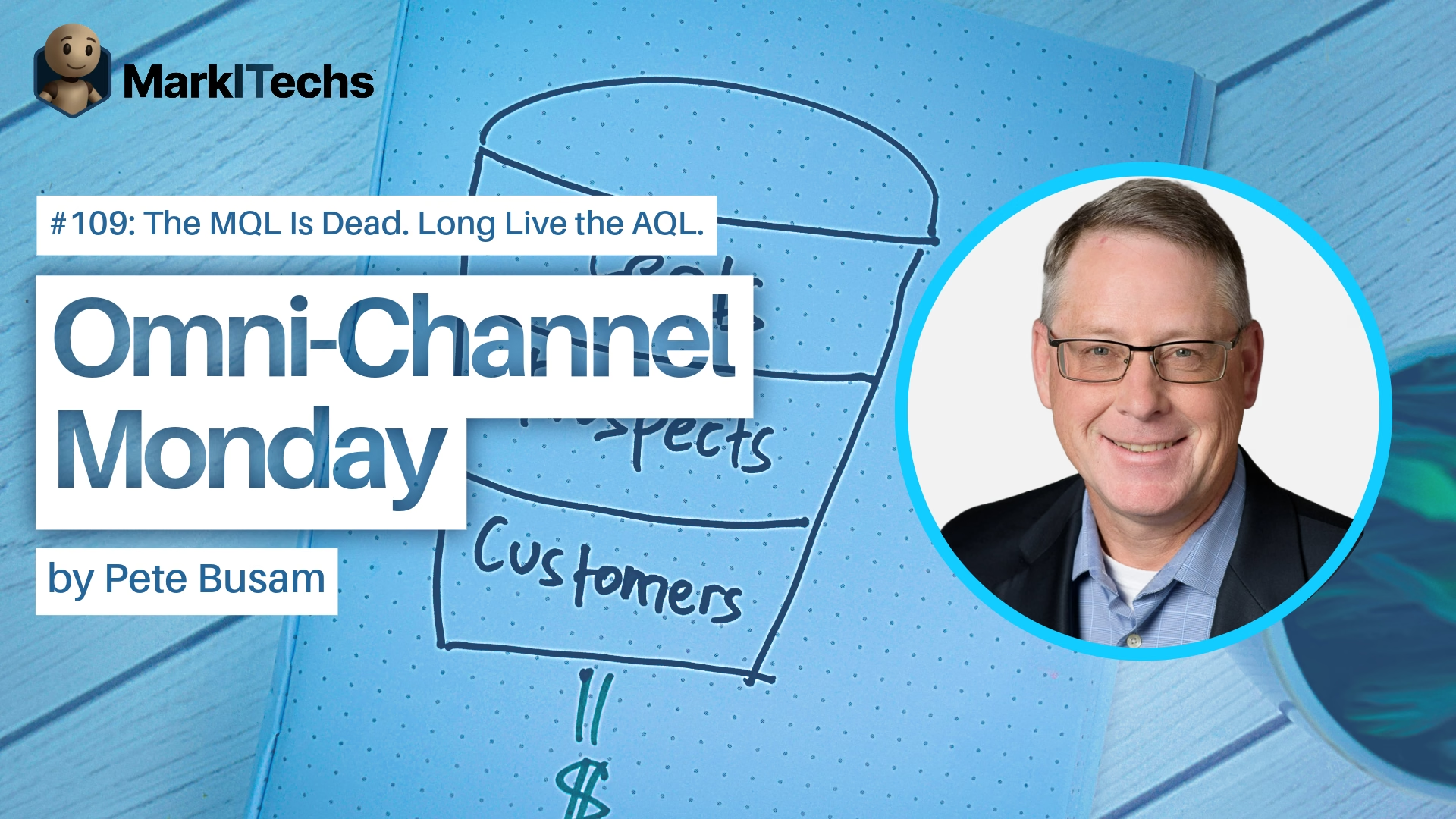
The MQL Is Dead. Long Live the AQL
Why Agent Qualified Leads Could Change MSP Marketing and Sales
We’ve spent years celebrating marketing qualified leads. Someone downloads an eBook, registers for a webinar, visits a few pages on our website, and suddenly marketing has another lead to hand over to sales.
The salesperson makes the call, discovers the person isn’t buying anything, and wonders why marketing thought the lead was qualified in the first place.
Sound familiar?
Now imagine something different. Instead of assigning points based on what somebody clicked, an AI agent has a conversation with that person. It learns what they’re trying to accomplish, whether their company fits the MSP’s ideal client profile, what challenges they’re facing, and whether there’s a reason to speak with sales.
By the time the salesperson gets involved, there’s more than a name, email address, and engagement score waiting in the CRM.
There’s context.
The industry has started calling this an Agent Qualified Lead, or AQL. And while I’m not convinced the marketing qualified lead is actually dead, I do believe we may be looking at a meaningful change in how MSPs qualify prospects.
More importantly, we may finally have an opportunity to address one of the oldest disagreements between marketing and sales.
What exactly makes a lead qualified?
We Built an Entire System Around Guessing
The marketing qualified lead, or MQL, wasn’t a bad idea. Marketing needed a way to distinguish casual interest from meaningful engagement, and sales needed some indication of which prospects deserved attention.
So we developed scoring systems.
A website visit earned points. Downloading a resource added more. Attending a webinar might push the score higher. When the prospect crossed a threshold, marketing declared the lead qualified.
That process can still provide useful information. The problem begins when we confuse engagement with buying intent.
Consider an IT director who downloads a cybersecurity guide because they’re researching a topic for an internal presentation. They might visit several related pages and open a follow-up email. Their engagement score looks impressive, but they have no intention of changing MSPs.
Meanwhile, a CFO at an 80-person manufacturing company might visit your website once, review your managed services offering, and leave without filling out a form.
That CFO could be actively evaluating providers because the company just acquired another business. Yet the person who downloaded the guide may receive more attention from sales.
Neither interaction tells the whole story.
We’ve explored this distinction in our earlier OCM discussions about AI agents, buyer intent, and the difference between identifying a company that fits your ICP and recognizing when that company might actually be ready for change.
A good prospect isn’t necessarily a buyer. And an interested visitor isn’t necessarily a qualified opportunity.
The MQL model can struggle with that distinction because it often relies on interpreting behavior rather than understanding the reason behind it.
What Is an Agent Qualified Lead?
An Agent Qualified Lead (AQL) is a prospect qualified through a structured AI-led conversation that establishes the buyer’s needs, fit, constraints, and intended next step.
The term was introduced by Docket in its definition of Agent Qualified Lead, published in May 2026. Its approach focuses on documenting what a buyer actually says during an AI-led interaction rather than relying primarily on behavioral scoring.
That’s an important distinction, although AQL is still an emerging term rather than a universally adopted industry standard.
The concept isn’t simply putting a chatbot on your website and calling everyone who interacts with it qualified. An agent needs to understand the business, ask relevant questions, evaluate the answers against defined criteria, and know when a conversation should move to a person.
For an MSP, those criteria might include company size, industry, geography, technical environment, service requirements, current provider situation, and the reason someone is considering a change.
The agent should also understand where the buyer is in the decision process.
A company exploring cybersecurity requirements for next year’s budget is different from one that needs a new managed services agreement in 60 days. Both might be good prospects, but they shouldn’t receive the same response.
This is where AQLs could become more useful than traditional MQLs.
Instead of telling sales that a prospect scored 85 points, marketing could explain why the prospect appears qualified, what they want to accomplish, and what should happen next.
Two Leads Walk Into Your CRM
Let’s imagine an MSP serving professional services firms and manufacturers across a defined regional market.
The first lead comes from a cybersecurity campaign. Someone downloads a checklist, attends a webinar, and visits the website several times. The CRM assigns a high score, and the contact becomes an MQL.
Sales follows up and discovers that the person is a junior employee researching cybersecurity awareness materials. The company already has an internal IT department and isn’t evaluating outside services.
The engagement was real. The buying opportunity wasn’t.
Now consider another visitor.
A director of operations arrives on the MSP’s website and begins interacting with an AI agent. During the conversation, the director explains that the company has 110 employees across three facilities. Its internal IT manager is overwhelmed, leadership is concerned about downtime, and a recent acquisition has complicated the technology environment.
The company isn’t necessarily unhappy with its current arrangements. However, it needs additional capacity and wants to understand whether co-managed IT might be appropriate.
The agent asks about the existing environment, supported locations, decision-making process, and timing. It determines that the company fits the MSP’s target market and that the director wants to schedule a discovery conversation.
With the buyer’s permission, that context is passed to sales.
Which lead would you rather receive?
The first demonstrates engagement. The second provides evidence of fit, a defined business need, and an agreed next step.
That doesn’t guarantee the second prospect will buy anything. The salesperson still needs to validate the information, understand the decision-makers, and determine whether the MSP can deliver what the customer needs.
But the first conversation can begin somewhere other than square one.
And that alone could make a meaningful difference.
The AQL Doesn’t Eliminate the Buyer Journey
Here’s where I would be careful about declaring the MQL dead.
Not everyone visiting an MSP website is ready for a sales conversation. Some are researching future projects. Others are comparing approaches, learning about compliance requirements, or trying to understand whether they need an MSP at all.
Those visitors still matter.
A well-designed AI agent should recognize when someone is early in the buyer journey rather than forcing every conversation toward a meeting.
Imagine a business owner asking whether an organization with 35 employees needs managed IT services. The agent might explain the differences between internal IT, outsourced managed services, and co-managed support. It could provide relevant educational content and help the visitor understand the options.
That conversation has value even if the visitor isn’t ready to buy.
In fact, forcing a sales appointment at that stage might damage the relationship before it begins.
This is why the underlying MSP marketing strategy still matters. Your ideal client profile, buyer personas, service positioning, and buyer journey should determine how prospects are engaged.
AI doesn’t replace that work.
It depends on it.
An agent that doesn’t understand who your MSP serves, what problems it solves, and where its capabilities begin and end may simply automate the same poor qualification decisions marketing was making before.
Only now, it can make them faster.
Your Agent Can Only Qualify What It Understands
This brings us to something we’ve discussed throughout the AI-agent series.
What information are we giving these agents, and can we trust it?
An MSP might have a website describing managed IT, co-managed IT, cybersecurity, cloud services, and strategic consulting. But those service descriptions may not explain which organizations are a good fit, how responsibilities are divided, what is included, or which requirements need further discussion.
A human salesperson can often fill in those gaps through experience.
An AI agent needs access to reliable, approved information and clear instructions about what it can and cannot say.
Consider a prospect asking whether the MSP can support a specific compliance requirement. The agent shouldn’t confidently promise a service simply because the website mentions compliance.
It should explain the MSP’s capabilities accurately, identify where additional discovery is required, and bring the appropriate person into the conversation.
We’ve already explored the risks of AI-generated commitments in our earlier discussion of AI sales agent governance. The same concerns apply during qualification.
An AQL isn’t particularly valuable if the agent qualified the prospect using inaccurate information or made promises the MSP cannot fulfill.
That’s also why the Equilibrium TrustStack™ approach becomes relevant. Alignment between ICP, messaging, buyer expectations, and execution isn’t just a marketing discipline anymore. It can become part of the information foundation that AI uses to represent the business.
If your website, service descriptions, sales materials, and CRM all tell different stories, your agent may struggle to determine which one is correct.
Before asking AI to qualify buyers, perhaps we should make sure the business has clearly defined what a qualified buyer actually looks like.
The Next Conversation Might Be Between Two Agents
Now let’s move this idea forward.
So far, most AQL discussions focus on an AI agent interacting with a human website visitor. But we’ve already explored the possibility that a prospect’s AI agent may research MSPs, compare capabilities, and help narrow the field before a human makes contact.
What happens when those two worlds meet?
Imagine a CFO instructing an AI agent to research managed service providers for a company with 200 employees, multiple locations, and specific compliance requirements.
The buyer’s agent reviews available providers and identifies several that appear to fit.
Eventually, it encounters an MSP whose website or approved agent interface can answer questions about supported industries, geographic coverage, service capabilities, onboarding approach, and qualification requirements.
In principle, the agents could exchange authorized information and identify whether the organizations are worth introducing to one another.
That doesn’t mean an AI agent should negotiate contracts, disclose confidential business information, or make purchasing commitments without appropriate authorization.
Nor does it mean every automated inquiry should become an AQL. The agent may be researching broadly, and the human buyer may not have authorized a sales conversation.
But it raises an interesting possibility.
We may eventually need to distinguish between a lead qualified through a conversation with a human and an opportunity identified through an authorized interaction between agents.
The underlying questions remain familiar: Is the company a fit? Is there a real need? Who has decision-making authority? Is there evidence of intent? What happens next?
The difference is that some of the early work could happen before a human salesperson becomes involved.
And that makes accurate, accessible, consistent information about your MSP increasingly important.
Sales Still Has to Believe the Qualification
There is another problem we shouldn’t overlook.
Marketing can introduce a new acronym, deploy an AI agent, and begin reporting AQLs. But if sales doesn’t trust the qualification, we haven’t improved anything.
We’ve just created a new argument.
The real test isn’t how many conversations an agent handles or how many AQLs it produces. It’s whether those conversations lead to legitimate sales opportunities and, eventually, customers.
An MSP should be able to review why a lead was qualified, what information the buyer provided, which questions remain unanswered, and whether a next step was actually agreed upon.
Sales should also have a way to challenge the qualification.
Perhaps the prospect appeared to fit the ICP but operates outside the MSP’s service geography. Maybe the stated timeline was misunderstood, or the buyer was researching for another organization.
Those findings should improve the qualification process rather than disappear into another dashboard.
I would also resist the temptation to compare raw MQL and AQL conversion rates without considering how the leads were selected. AQLs may represent a smaller group of buyers who were already willing to engage in deeper conversations. That alone can influence conversion rates.
The meaningful comparison is whether AI-led qualification improves accepted opportunities, meeting quality, sales efficiency, and eventual revenue compared with the process the MSP was using before.
That requires measurement, not just enthusiasm.
Maybe the MQL Isn’t Dead. Maybe Its Job Is Changing.
I don’t believe we should throw away everything we’ve learned about marketing engagement.
Website activity, email responses, content downloads, and campaign participation can still tell us something useful. They help identify interest, understand which subjects attract attention, and determine where additional education may be valuable.
But perhaps those signals shouldn’t automatically determine when sales gets involved.
An MQL could remain an indication that someone is engaging with the business. An AQL could represent a prospect who has participated in a meaningful AI-led qualification conversation and met defined criteria. Sales would then validate the opportunity and determine whether it should advance.
That creates a more useful distinction between interest, qualification, and opportunity.
For MSPs using HubSpot or another CRM, this could mean maintaining engagement scoring while introducing separate fields for AI qualification, ICP fit, stated needs, buying stage, confidence, and agreed next steps.
The objective wouldn’t be to create another complicated reporting system.
It would be to give marketing and sales a shared understanding of what makes a prospect worth pursuing.
And that brings us back to a familiar problem.
Marketing wants credit for creating demand. Sales wants conversations with organizations that have a reason to buy. MSP owners want to know whether their investment is producing meaningful pipeline.
The AQL concept won’t solve those disagreements by itself.
But it could give us better information to work with.
The MQL Is Dead. Long Live the AQL.
We’ve spent the last several OCMs considering how AI agents might change the way MSPs attract prospects, support sales, make commitments, onboard customers, and demonstrate business value.
Now we’re back at the beginning of the relationship, asking whether the way we qualify a lead needs to change.
I think it does.
Not because every MQL is worthless, or because every AI conversation produces a better prospect. Neither claim would be fair.
The opportunity is to stop treating marketing activity as though it automatically proves buying intent.
If an AI agent can help a prospect explain what they need, determine whether the MSP is a good fit, and establish a sensible next step, sales may begin with a much better understanding of the opportunity.
That’s worth exploring.
But the real measure of success won’t be how many AQLs appear in a report. It will be whether those leads become productive conversations, legitimate opportunities, and customers the MSP is well-positioned to serve.
So here’s the question I’d leave MSP owners with this week.
Would you rather receive 100 MQLs based on engagement scores or 10 AQLs with documented needs, verified fit, and a genuine reason to talk?
I suspect most salespeople already know their answer.
The more interesting question is whether marketing is ready to change what it measures.
Better Qualification Starts Before the First Conversation
An AI agent can only qualify prospects effectively when the MSP has clearly defined its ideal clients, service capabilities, buyer personas, and qualification criteria.
At Equilibrium Consulting, we help MSPs build that foundation through a disciplined approach to positioning, content, SEO, AI visibility, marketing technology, and sales alignment.
Explore our MSP Marketing Services to see how we connect buyer understanding, marketing execution, and measurable pipeline development.
Frequently Asked Questions
What is an Agent Qualified Lead (AQL)?
An Agent Qualified Lead is a prospect qualified through a structured conversation with an AI agent. The agent gathers information about the buyer’s needs, company fit, constraints, and intends next step before passing the opportunity to sales.
Unlike a traditional MQL, which may be based largely on behavioral scoring, AQL includes information the buyer provided directly during the interaction.
The term was introduced by Docket in 2026 and is still emerging rather than being a universally adopted marketing standard.
What is the difference between AQL and MQL?
An MQL generally indicates that a prospect has demonstrated enough engagement or fit to meet marketing qualification criteria. An AQL is based on an AI-led conversation that documents the buyer’s stated needs, qualification status, and next step.
An MQL may tell sales that someone has shown interest. An AQL can provide more context about why the person may be worth contacting.
Neither automatically guarantees buying intent or a sales opportunity.
Are Agent Qualified Leads better than Marketing Qualified Leads?
AQLs can provide more actionable information because they document a buyer’s answers rather than relying only on engagement signals. That may help salespeople prepare for conversations and reduce unnecessary qualification work.
However, their effectiveness depends on the AI agent’s quality, the accuracy of its information, and the qualification criteria used.
MSPs should compare sales acceptance, opportunity creation, conversion, and revenue outcomes before concluding that AQLs outperform their existing process.
How can MSPs use AI agents to qualify leads?
An MSP can use an AI agent to answer buyer questions, gather relevant business information, assess fit against its ideal client profile, and determine whether a human sales conversation is appropriate.
The agent should use approved service information and follow clear rules about pricing, scope, commitments, privacy, and escalation.
With the buyer’s permission, qualified conversations can then be recorded in the CRM, including the stated need, key constraints, unresolved questions, and next step.
Will AQLs replace MQLs in MSP marketing?
AQLs may become a useful additional qualification category, particularly for MSPs adopting conversational AI. However, MQLs can still help measure early engagement and identify prospects who are not ready for sales.
Many MSPs may benefit from using both approaches, with engagement data supporting nurturing and AI-led qualification providing additional context when buyers are ready to interact.
The important decision is not which acronym survives. It is how effectively marketing and sales identify, qualify, and develop real opportunities.
About the Author: Pete Busam

Share This Story, Choose Your Platform!
Related Posts