The Invisible Shortlist: Your Company Lost the Deal Before You Knew There Was One
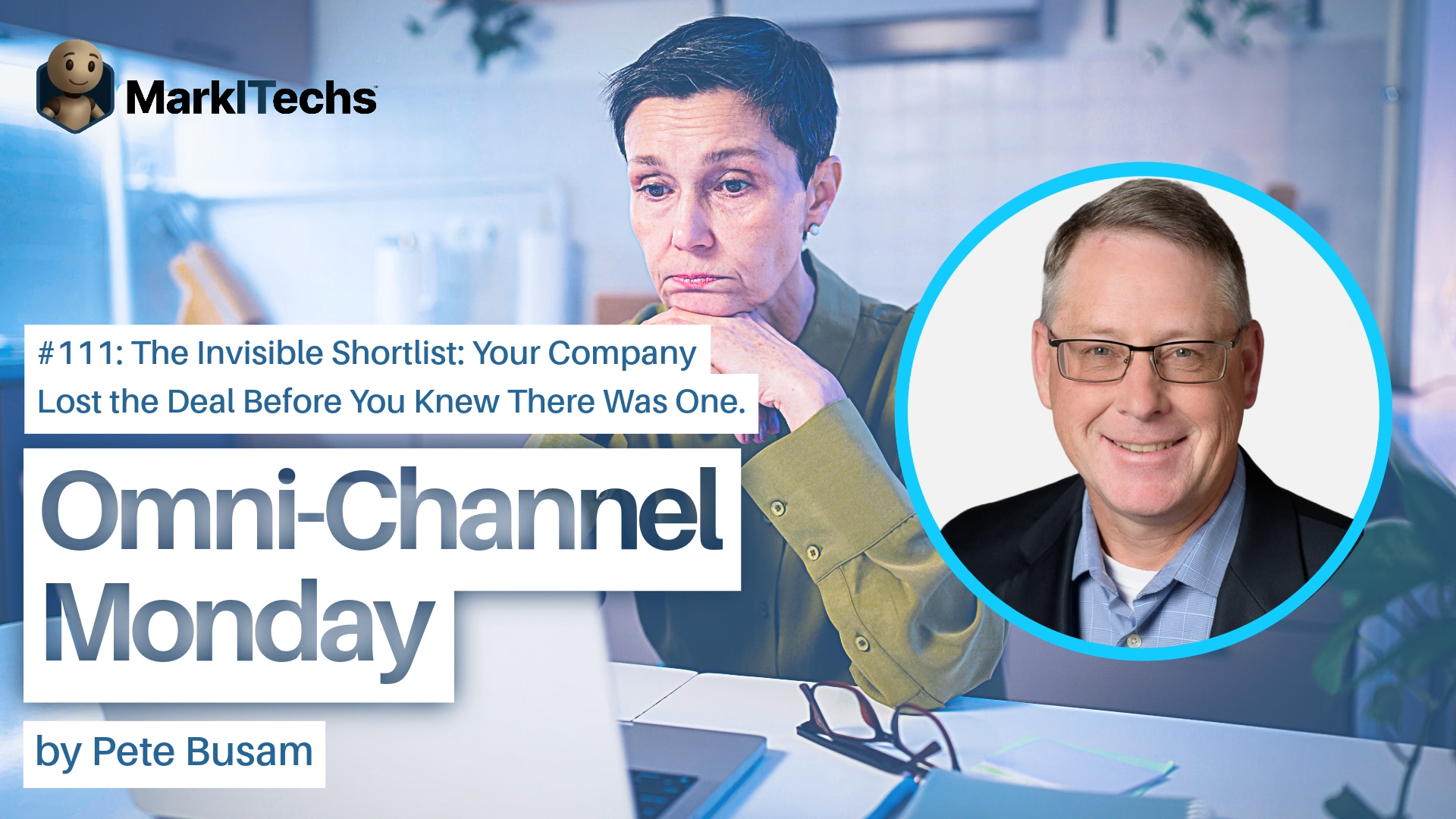
AI vendor shortlisting may be changing who gets considered for business before a salesperson even knows an opportunity exists.
Think about that for a minute.
You’ve invested in your website, improved your search rankings, built a social following, and developed a respectable collection of customer reviews.
Your marketing reports show progress. Traffic is growing. Your content is reaching more people. Everything seems to be moving in the right direction.
Meanwhile, a company in your market is looking for a new managed IT provider.
They’re a perfect fit for your business. Right industry, right size, right location, and a genuine need for your services.
You never hear from them.
Not because your sales team failed to follow up. Not because your pricing was too high. Not even because a competitor outperformed you in a sales presentation.
You weren’t on the list.
And here’s the really uncomfortable part. You may never know you were considered.
Welcome to the invisible shortlist.
The Buying Conversation You Never Got Invited To
Let’s imagine a manufacturing company with 150 employees.
Its current MSP isn’t meeting expectations. Support tickets take too long, cybersecurity concerns are growing, and leadership wants a provider that understands manufacturing operations.
Five years ago, the company’s president might have asked a colleague for recommendations. Perhaps someone searched Google, visited several websites, and scheduled a few conversations.
Today, that president might open ChatGPT, Gemini, or Perplexity and ask:
“Find five managed IT providers that support manufacturers with 100 to 250 employees in our region. We need cybersecurity, business continuity, and experience with production environments.”
Within moments, an AI assistant may produce a shortlist.
The president reviews the recommendations, asks a few follow-up questions, and decides which companies deserve a conversation.
Your company isn’t included.
Now, we shouldn’t pretend that every buyer behaves this way. Nor should we assume AI recommendations are always accurate, complete, or consistent.
But the scenario raises a question that every MSP owner and marketing leader should be asking.
What happens to your marketing strategy when the buyer never reaches your website?
AI Vendor Shortlisting Changes the First Impression
For years, marketers have worked to earn the first impression.
We optimized websites, improved search visibility, invested in advertising, and created content that answered buyer questions.
The objective was straightforward. Get discovered, earn the visit, establish credibility, and create an opportunity for engagement.
AI-assisted buying can interrupt that sequence.
Instead of reviewing ten websites, a buyer may ask an AI assistant to compare ten providers and recommend three.
The assistant becomes an intermediary between the buyer and the businesses competing for attention.
That doesn’t mean websites are becoming irrelevant. Quite the opposite.
The information on your website, along with credible external information, may help inform those recommendations.
However, the buyer might consume a summary without visiting the underlying sources.
This is where traditional marketing assumptions break down.
A business could influence a recommendation without receiving a website visit. Another could be excluded because the available information failed to establish a clear fit.
Neither outcome necessarily appears in your analytics.
And that brings us to something I’ve been thinking about for a while.
Are we measuring the effectiveness of our marketing, or just the activity we can see?
The AI Reality Check: Would AI Put Your MSP on the List?
Rather than simply predict what AI might do, let’s put the concept to a practical test.
Take a business scenario that closely matches your ideal client profile.
For example, imagine a 125-person manufacturing company seeking a managed IT provider with cybersecurity expertise, operational technology awareness, and business continuity capabilities.
Now ask ChatGPT, Gemini, and Perplexity to recommend suitable providers in your actual service area.
Don’t tell the systems your company’s name.
Don’t ask them to evaluate your website.
Let them develop their recommendations from the information they can access.
Then examine the results.
Did your company appear? Which competitors were recommended? What evidence supported those recommendations? Did the systems correctly understand each provider’s capabilities?
Most importantly, did they explain why one company was more appropriate than another?
This is exactly the kind of question behind Equilibrium Consulting’s AI Reality Check.
The goal isn’t to convince an AI platform to recommend your company. It’s to understand how AI-assisted discovery may interpret your business, its expertise, and its relevance to potential buyers.
A single test isn’t a scientific ranking system. AI recommendations can change with the prompt, location, model, available sources, and timing.
Nevertheless, comparing results across systems can expose gaps in how your company communicates its value.
Perhaps your manufacturing experience isn’t clearly documented. Maybe your cybersecurity qualifications are difficult to verify. Or your website doesn’t explain the size and type of organizations you serve.
Those findings are useful, whether or not an AI platform includes your company in a particular response.
The real question isn’t whether AI likes your company. It’s whether AI can understand what makes your company relevant.
Your Competitor May Be Winning a Conversation You Cannot Measure
Here’s where this becomes particularly interesting for CROs.
Imagine two MSPs competing in the same region.
Both have capable technical teams. Both deliver quality service. Both have established customer relationships.
The first has a modern website filled with broad claims about proactive support, reliable technology, and customer satisfaction.
The second clearly explains the industries it serves, the operational challenges it understands, and the business outcomes it has helped customers achieve.
It also keeps company information consistent across relevant industry directories, customer reviews, and professional profiles.
Which company is easier for an AI assistant to evaluate against a specific buyer request?
The second provides more explicit evidence of fit.
That doesn’t guarantee a recommendation. AI systems have limitations, and their outputs aren’t always predictable.
However, the difference illustrates something important.
Marketing differentiation cannot live exclusively inside a sales presentation.
If your experience, specialization, and credibility aren’t accessible during the research process, a potential buyer may never discover them.
We’ve previously explored this challenge in Your Next Prospect May Not Be Human.
Now the conversation moves beyond attracting AI-assisted buyers.
We’re asking what happens when your company doesn’t make their initial list.
The Real Problem May Not Be Visibility
It’s tempting to look at this challenge and immediately conclude that businesses need more SEO, more content, or more AI optimization.
Maybe they do.
But I think that misses something more fundamental.
You can be highly visible and still be poorly understood.
An MSP might rank well for managed IT services but offer little evidence of its experience supporting manufacturers.
Another might publish dozens of cybersecurity articles without clearly explaining its compliance capabilities or service boundaries.
A third might have excellent customer relationships but almost no independently verifiable evidence of those outcomes.
Each company has a different problem.
More traffic alone won’t necessarily solve any of them.
This is why we’ve spent so much time discussing the relationship between an ideal client profile, buyer personas, and the actual buying journey.
If you don’t understand who you serve and why customers choose you, how can you expect an AI assistant to make that connection?
At Equilibrium Consulting, our TrustStack™ framework aligns positioning, buyer needs, credibility, and marketing execution.
That framework has its own purpose. The invisible shortlist introduces another reason the alignment matters.
Your digital presence needs to reflect your real business, not simply the keywords you hope to rank for.
What Your Analytics Won’t Tell You
Let’s return to the marketing dashboard.
Your organic traffic increased 15%. Engagement improved. Your average search position moved in the right direction.
Those are useful indicators.
But suppose five potential buyers asked AI assistants to recommend providers in your market.
Three received recommendations that excluded your company.
One received a recommendation that included you but selected another provider.
The fifth contacted you after reviewing several options.
What would your analytics show?
Possibly one conversion and little evidence of the other four evaluations.
This example is hypothetical, but the measurement problem is real.
Traditional analytics primarily measure observable interactions. They cannot reliably reconstruct every recommendation, conversation, or decision made outside your digital properties.
That creates a potential blind spot in marketing attribution.
It also challenges the way agencies and internal marketing teams demonstrate value.
We’ve spent years explaining the difference between impressions, engagement, leads, and actual pipeline.
Now we may need to account for another influence: whether a business enters the buyer’s consideration set at all.
And if we cannot directly observe every shortlist, we’ll need better ways to evaluate our visibility and validate what marketing is contributing.
That’s a conversation I suspect will make a few CROs uncomfortable.
You Cannot Optimize Your Way Around a Weak Business Story
Before everyone rushes to create another hundred AI-friendly articles, consider this.
What if the problem isn’t your content volume?
What if your company simply hasn’t explained why a particular buyer should choose you?
The same generic language appears across countless MSP websites.
Proactive support. Strategic technology. Trusted partner. Peace of mind.
There’s nothing inherently wrong with those promises.
But when every competitor makes them, they provide little meaningful differentiation.
Now imagine an AI assistant comparing those companies.
Without specific evidence, how should it determine which provider genuinely understands a manufacturer’s production environment or a defense contractor’s compliance obligations?
That’s where original experience becomes valuable.
Customer outcomes, relevant certifications, documented expertise, and clear service expectations help establish a more complete picture.
This also connects to a point we raised in The Authority Meritocracy.
Authority should be earned through substance, not simply purchased through visibility.
Of course, we also need to recognize that AI systems can misunderstand or overlook credible evidence.
No amount of optimization guarantees inclusion.
Still, businesses have control over the quality, clarity, and consistency of the information they publish.
That’s a reasonable place to start.
The Shortlist Is Invisible. Your Business Shouldn’t Be.
I don’t believe AI is eliminating the importance of relationships.
In many ways, it may make them more valuable.
But relationships cannot develop when the buyer never discovers that your company might be a good fit.
That’s the real challenge.
Marketing has always been responsible for creating awareness and helping the right buyers understand a company’s value.
AI-assisted research doesn’t eliminate that responsibility.
It changes where some of that work happens.
For MSPs, the answer isn’t to abandon traditional SEO, chase every AI platform, or manufacture content designed to impress an algorithm.
It’s to make sure the business you present online accurately reflects the business your customers experience.
Your website should explain your expertise. Your external reputation should support your claims. Your content should address the concerns of your actual buyers.
And your marketing strategy should connect those pieces rather than treating them as separate activities.
That’s also why MSP marketing services need to account for both human engagement and AI-assisted discovery.
The fundamentals haven’t disappeared.
The buying environment is changing around them.
Before You Celebrate Your Rankings, Ask One More Question
We’ve spent the past several weeks discussing AI agents, automated sales conversations, Agent Qualified Leads, and the growing importance of trust.
The invisible shortlist introduces another consequence.
You can lose an opportunity without ever knowing you were competing for it.
That doesn’t mean every AI recommendation represents a real buying opportunity. It doesn’t mean rankings no longer matter.
And it certainly doesn’t mean we should trust every answer an AI platform produces.
But it does mean we need to challenge some long-standing assumptions about visibility and marketing performance.
The next time someone presents a dashboard filled with improving numbers, ask a different question.
“Are we showing up when the right buyers are deciding whom to consider?”
Because getting found is important.
Getting considered is what creates the opportunity.
And if you’re not on the shortlist, your sales team never gets the chance to explain why you should have been.
That’s a pretty expensive conversation to miss.
Put Your Own Business to the Test
Equilibrium Consulting developed the AI Reality Check to help businesses explore how AI-driven discovery may represent their company.
The tool is free to use, and the information you enter isn’t sent to Equilibrium Consulting.
It’s a practical starting point for examining whether your digital presence communicates the expertise, relevance, and credibility that buyers need to evaluate.
If the results raise bigger questions about your positioning, buyer journey, or marketing performance, that’s a conversation worth having.
At Equilibrium Consulting, we help MSPs and technology companies connect those pieces into a disciplined growth strategy.
Don’t wait for a lost opportunity to discover that you were never in the conversation.
Frequently Asked Questions
What is AI vendor shortlisting?
AI vendor shortlisting uses artificial intelligence to help identify, compare, and narrow potential suppliers or service providers.
A buyer may describe business requirements to an AI assistant and request recommendations based on industry experience, services, geography, or other criteria.
The assistant may then summarize available information and produce a list of potential providers.
However, recommendations can vary between systems and may contain errors or omissions. Buyers should verify important claims before making purchasing decisions.
For MSPs, this creates another discovery environment where clear positioning and credible information can influence consideration.
Can an MSP lose business because it doesn’t appear in AI recommendations?
Potentially, yes.
If a buyer relies on AI-generated recommendations to create an initial shortlist, a provider that isn’t included may never get the chance to compete.
However, appearing in an AI response does not automatically create a qualified lead. Likewise, exclusion from one response doesn’t prove that a business has lost an actual sale.
The concern is that AI-assisted research may influence consideration before direct engagement occurs.
MSPs should evaluate how accurately their businesses are represented across relevant digital sources rather than relying on one AI recommendation as a definitive measure.
How can MSPs determine whether AI platforms recommend their company?
Start with realistic buying scenarios that reflect your ideal client profile.
Ask multiple AI platforms to recommend providers that meet those requirements without naming your company.
Record the recommendations, supporting sources, and explanations.
Then repeat the exercise using consistent prompts and document any changes.
Equilibrium Consulting’s AI Reality Check provides a starting point for examining how a company’s digital presence may be interpreted in AI-assisted discovery.
These tests should not be treated as comprehensive market research.
A meaningful assessment should also consider traditional search visibility, customer feedback, competitive positioning, and actual pipeline performance.
Does AI vendor shortlisting replace traditional SEO?
No. AI-assisted discovery introduces additional ways for buyers to research companies, but traditional search remains important.
Websites, search engines, industry directories, and other accessible sources can contribute information that AI systems use or summarize.
Strong SEO fundamentals help businesses maintain accessible, understandable content.
However, traditional rankings do not guarantee AI recommendations.
Businesses should focus on accurate information, relevant expertise, useful content, and credible external validation while measuring performance across multiple discovery channels.
Why does AI-assisted buying make marketing attribution more difficult?
Marketing attribution depends on observable interactions, such as website visits, campaign responses, form submissions, and CRM activity.
When buyers research through AI assistants, some activity may occur outside a company’s measurable digital properties.
A buyer could encounter a company through an AI-generated recommendation without clicking through to its website.
Conversely, a company might be excluded from a recommendation without receiving any indication that an evaluation occurred.
This creates gaps in traditional reporting.
Marketing leaders should combine digital analytics with customer discovery questions, CRM information, and other evidence to better understand how buyers find and evaluate providers.
About the Author: Pete Busam

Share This Story, Choose Your Platform!
Related Posts