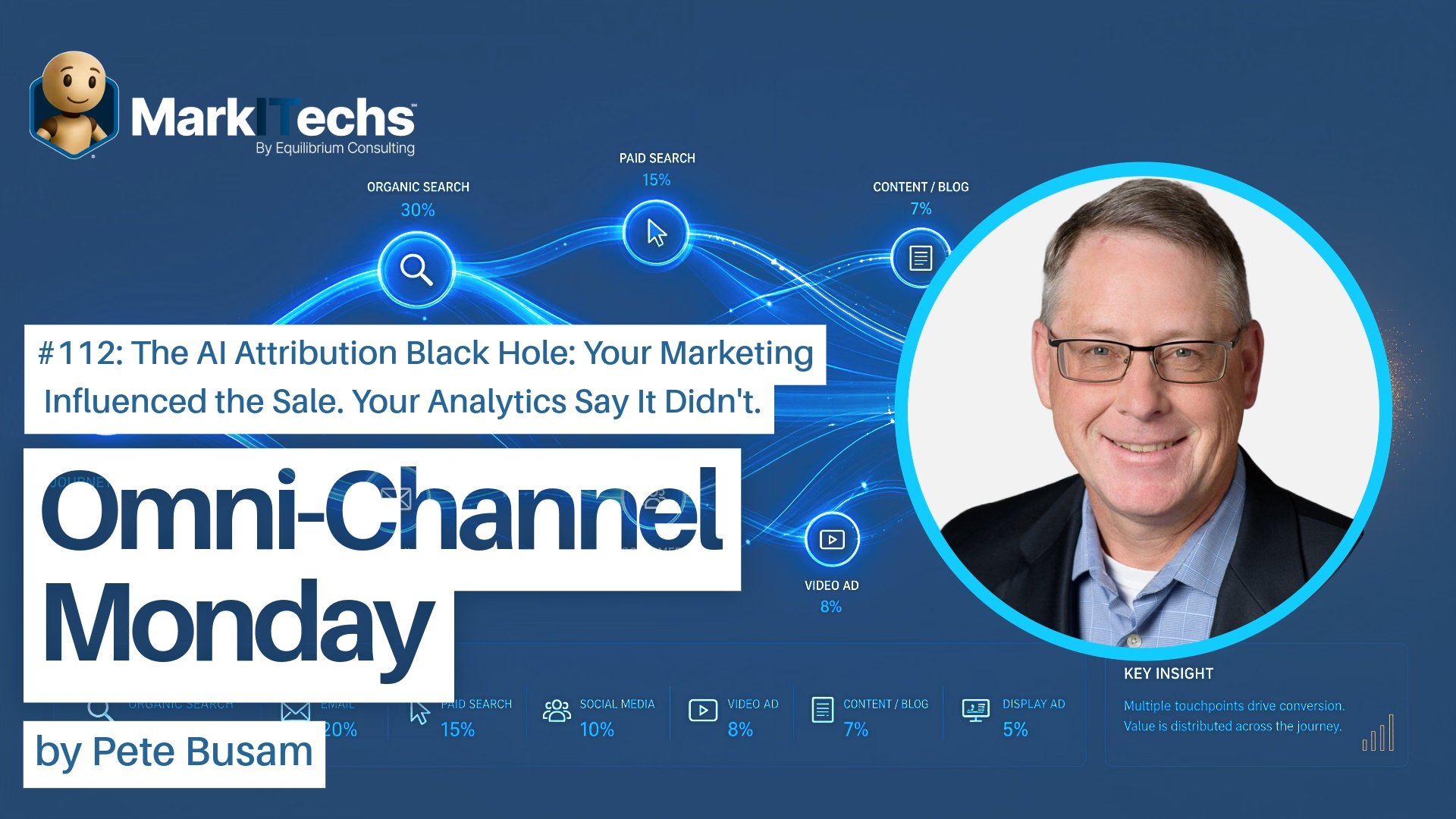
The AI Attribution Black Hole: Your Marketing Influenced the Sale. Your Analytics Say It Didn’t.
Your company just landed a new customer worth $60,000 annually. The sales team is celebrating, the owner is happy, and someone moves the opportunity to closed-won in the CRM. Everything looks great until the next marketing review.
The CRM says the opportunity came from a referral. Google Analytics shows no meaningful conversion activity, and none of your recent campaigns can claim the lead. From a reporting standpoint, marketing contributed very little.
But what if that customer spent the previous three weeks researching your company, reading your content, reviewing your reputation, and asking AI whether you were worth considering?
That’s where AI marketing attribution starts getting interesting. We may be entering a period when marketing influences more of the buying decision than our reporting systems can demonstrate.
And before anyone accuses me of making excuses for marketing agencies, I’m not suggesting we stop measuring results. Quite the opposite. I think we need to get considerably better at understanding what actually contributes to revenue.
The Customer Journey Didn’t Start Where Your CRM Says It Did
Let’s use a manufacturing company as an example. Its leadership team has grown frustrated with its managed IT provider. Support has become inconsistent, cybersecurity concerns are increasing, and production downtime is becoming expensive. The president decides it’s time to explore alternatives.
Rather than immediately searching Google and visiting a dozen MSP websites, the president opens an AI assistant and describes the business. They want a provider with manufacturing experience, cybersecurity expertise, and an understanding of operational technology.
Several companies appear in the response. One stands out because its website clearly explains manufacturing challenges, its customer stories demonstrate relevant experience, and independent reviews support its reputation.
The president continues researching, perhaps asking AI to compare providers or explain the differences between their services. Eventually, the president mentions one company to a colleague.
“I’ve heard of them. They’re good people. You should give them a call.”
A week later, the president contacts the MSP directly.
Now, ask your sales team where that opportunity came from. They’ll probably say referral, and they wouldn’t necessarily be wrong. The colleague’s recommendation helped move the buyer toward a conversation.
But it wasn’t the beginning of the journey. The buyer had already spent time evaluating the company, and marketing may have played a significant role in that process.
The problem is that most of those interactions happened outside the MSP’s measurable digital properties.
The buyer experienced an entire journey. The CRM recorded the last chapter.
We’ve always had some version of this problem. Buyers have talked to colleagues, attended conferences, read articles, and formed opinions long before contacting a salesperson. AI didn’t create that behavior. However, it may accelerate the research process while making it harder to observe.
That’s why I believe the conversation around marketing attribution needs to change.
We’re Measuring Activity. Are We Measuring Influence?
For years, we’ve built marketing reports around the information our platforms can collect. Website traffic, keyword rankings, email engagement, form submissions, and campaign conversions all have their place. They’re useful indicators, and I wouldn’t recommend abandoning any of them.
But there’s a difference between knowing what someone clicked and understanding why they decided to buy.
Think about your own purchasing decisions. How often have you researched a company, spoken with colleagues, reviewed its reputation, and then contacted someone directly? Did the last website you visited deserve all the credit for your decision?
Probably not.
Yet that’s effectively what happens when businesses rely too heavily on a single attribution source.
Now add AI-assisted research to the equation. A prospect can ask an AI assistant to compare MSPs, evaluate their industry experience, or identify potential concerns without visiting every company’s website.
The assistant might reference your company’s expertise, summarize customer evidence, or include you among its recommendations. If the buyer never clicks through, your analytics may have no record of that interaction.
Google Analytics can measure certain AI referral visits, and attribution models can help assign credit across observed interactions. Google’s attribution documentation explains how these models work.
However, no attribution model can reconstruct every conversation a buyer has outside your measurable environment.
That leaves us with an uncomfortable question.
Are we evaluating marketing based on its contribution to business growth, or simply the activity our software can see?
The Invisible Shortlist Was Only Half the Story
Last week’s OCM explored The Invisible Shortlist, where we challenged the idea that a company always knows when it’s competing for business.
An AI-assisted buyer might evaluate several providers and eliminate your company before you ever receive a website visit or sales inquiry. You could lose an opportunity without knowing it existed.
But what happens when the opposite occurs?
Your company makes the shortlist. The buyer reviews your expertise, validates your reputation, and eventually becomes a customer. The deal closes, yet the reporting doesn’t connect those early influences to the outcome.
In one situation, you lose without knowing you competed. In the other, you win without fully understanding why.
Both create problems for marketing leaders trying to determine which investments deserve more attention.
And this is where I think we need to challenge some of the assumptions behind marketing performance reporting.
We’ve spent years debating first-touch attribution, last-touch attribution, and multi-touch models. Those discussions still matter, but they only address interactions we can observe or reasonably model.
They don’t necessarily explain the buyer’s decision.
For MSPs, that’s a significant distinction because we’re not selling impulse purchases. We’re asking customers to trust another organization with their technology, security, employees, and business continuity.
Those decisions involve confidence, reputation, and relationships. Marketing can help establish all three, even when the final conversation happens through a referral or direct phone call.
CROs: This Is Where the Conversation Gets Uncomfortable
Imagine you’re reviewing quarterly performance with your marketing team.
Organic traffic increased 20%. Search visibility improved, and LinkedIn engagement is moving in the right direction. Meanwhile, sales closed three new customers worth $180,000 in annual recurring revenue.
Two opportunities came through referrals. The third arrived through a direct phone call.
Your marketing report shows very little attributable revenue.
Naturally, the CRO asks, “What exactly are we getting for our marketing investment?”
That’s a legitimate question. Business owners should expect marketing to contribute to growth, and agencies should be prepared to explain their work in business terms.
However, I would challenge the CRO to ask a few additional questions before deciding that marketing didn’t contribute.
Did those customers know about the company before receiving a referral? Had they reviewed the website or customer stories? Did they encounter the business through AI-assisted research? What made them comfortable enough to schedule a conversation?
The answers may reveal influences that never appeared in the original lead source.
There’s an important distinction here. A referral can explain how someone contacted your business, while marketing may help explain why they trusted that recommendation.
Both can contribute to the same decision.
Of course, that doesn’t mean marketing deserves credit for every closed deal. I wouldn’t accept that argument from an agency, and I wouldn’t make it to a client.
Marketing influence must be supported by evidence, not assumed because a campaign happened to be running.
That’s where better conversations between sales and marketing become essential.
Maybe We Need to Ask Buyers Better Questions
One of the simplest improvements doesn’t require another analytics platform, expensive software, or a complicated attribution model.
It requires asking better questions during the sales process.
Most CRMs have a lead source field. Someone selects referral, organic search, paid advertising, or another category, and the opportunity moves forward.
That’s useful information, but it doesn’t tell the whole story.
What if sales also asked how the buyer first became aware of the company? What information helped them evaluate their options? Which competitors did they consider, and what ultimately influenced their decision to engage?
Those answers could reveal whether customer reviews, case studies, industry content, referrals, or AI-assisted research contributed to the decision.
They won’t provide perfect attribution. Buyers may not remember every interaction, and their explanations can be incomplete.
Nevertheless, consistently collecting that information creates another source of evidence.
Over time, patterns may emerge. Perhaps manufacturing prospects frequently mention industry-specific content. Maybe cybersecurity buyers place greater weight on certifications and customer evidence. Or perhaps more prospects are using AI to narrow their choices before contacting anyone.
Now we’re learning something that can actually improve marketing strategy.
Instead of simply reporting that traffic increased, we can begin connecting marketing activity to the reasons customers consider and choose a provider.
That’s a much more useful conversation.
Trust Doesn’t Always Show Up as a Conversion
There’s another reason this matters, particularly for managed IT providers.
A company can generate plenty of website traffic without establishing meaningful credibility. Conversely, a business with a smaller audience may attract highly qualified buyers because its positioning, experience, and reputation align with their needs.
That’s why I keep coming back to the relationship between an ideal client profile, buyer personas, and the actual buying journey.
If your marketing doesn’t reflect the concerns of the people you’re trying to reach, more traffic won’t necessarily create better opportunities.
At Equilibrium Consulting, our TrustStack™ framework connects positioning, buyer needs, credibility, execution, and measurement. It isn’t an attribution tool, and I don’t want to suggest otherwise.
Rather, it helps establish the alignment that makes marketing meaningful throughout the buying process.
When buyers research companies through AI, that alignment becomes even more important. An assistant may encounter your website, service descriptions, customer evidence, and external reputation before the buyer ever speaks with your team.
If those sources tell conflicting stories, the problem extends beyond measurement.
You may be undermining the very confidence your marketing is supposed to create.
Our AI Reality Check helps businesses begin examining how their digital presence may be represented during AI-assisted discovery. It doesn’t reveal every buyer conversation or prove that marketing generated a sale.
However, it can raise useful questions about whether your company is being accurately understood and considered.
And that’s information worth having.
Stop Giving the Dashboard the Final Word
I don’t believe the solution is to abandon analytics or replace measurable performance with vague claims about brand awareness.
That would be a mistake.
Marketing should remain accountable for qualified opportunities, pipeline contribution, customer acquisition costs, and revenue. Those measures help businesses determine whether their investments are producing meaningful results.
However, we need to recognize that marketing performance is more complex than a collection of clicks and form submissions.
A customer might discover your company on LinkedIn, validate its expertise with AI, get a recommendation from a colleague, and then call your office.
The CRM records the referral. Analytics may capture only a portion of the journey.
Neither system is necessarily broken. They’re reporting the information available to them.
The mistake happens when we treat that information as the complete explanation for why the customer bought.
This is why MSP marketing services should connect strategy, execution, sales feedback, and business outcomes rather than operating as disconnected campaigns.
We need to understand not only whether marketing is generating activity, but whether that activity is helping the right customers move toward a decision.
Sometimes the evidence will be direct. A campaign produces an inquiry that becomes a customer.
Other times, the contribution will be less obvious and require additional investigation.
Either way, the objective should be the same: make better decisions about what actually supports profitable growth.
Your Analytics Aren’t Wrong. They’re Just Not the Whole Story.
Let’s return to that $60,000 customer.
Sales closed the deal. The CRM recorded a referral, and marketing couldn’t demonstrate a directly attributable conversion.
Everyone might be accurately reporting what their systems observed.
But the buyer’s decision may have developed over weeks of research, recommendations, and credibility checks.
If we ignore those influences, we risk making marketing decisions based on an incomplete picture.
And if we automatically claim credit for them without evidence, we’re no better off.
That’s the balance marketing leaders need to find.
AI is changing how buyers discover and evaluate companies, but the underlying challenge remains familiar. We need to understand what influences purchasing decisions and invest in the activities that genuinely support growth.
That requires good analytics, better communication between sales and marketing, and a willingness to question what our dashboards are telling us.
Your marketing may have helped win the sale. Your analytics may never show it.
The question isn’t whether we should stop measuring.
It’s whether we’re willing to measure more intelligently.
Is Your Marketing Creating Revenue or Just Reporting Activity?
At Equilibrium Consulting, we believe marketing should connect strategy, execution, and measurable business outcomes.
That means understanding your ideal customers, aligning with their buying journey, and connecting marketing activity to meaningful pipeline opportunities.
If your reports look impressive but you’re struggling to explain how they contribute to growth, perhaps it’s time for a different conversation.
Not about producing another dashboard.
About understanding what actually moves your business forward.
Because marketing shouldn’t get credit for everything. But it shouldn’t disappear from the story simply because the buyer never clicked.
Frequently Asked Questions
What is AI marketing attribution?
AI marketing attribution examines how AI-assisted buyer research affects a company’s ability to identify the marketing interactions contributing to business outcomes.
As buyers use AI assistants to compare providers, evaluate expertise, and research purchasing decisions, some interactions may occur outside traditional tracking environments. A company could influence a recommendation without receiving a measurable website visit.
However, AI marketing attribution isn’t a single standardized measurement model. Businesses should distinguish between observed interactions, modeled attribution, and broader evidence of marketing influence.
For MSPs, the objective should be to combine analytics, CRM information, and buyer feedback to understand how prospects discover, evaluate, and ultimately select providers.
Why does AI-assisted buying make marketing attribution more difficult?
AI assistants allow buyers to research companies and compare services without visiting every provider’s website. When an assistant summarizes information or recommends a business without generating a click, traditional analytics may not record the interaction.
Buyers may also continue researching through colleagues, industry communities, and direct conversations before contacting a company. These activities can influence decisions without producing measurable digital conversions.
Some AI referral traffic is measurable, but it represents only interactions that reach a company’s tracked properties.
Marketing teams should therefore avoid treating website analytics as a complete record of buyer influence. Combining observable data with customer feedback provides a more useful perspective.
What is the difference between marketing attribution and marketing influence?
Marketing attribution assigns credit to identifiable interactions associated with a conversion or business outcome. Marketing influence describes the broader ways marketing may contribute to awareness, consideration, confidence, and purchasing decisions.
For example, a customer might contact an MSP after receiving a colleague’s recommendation. The CRM records the opportunity as a referral, even though the customer previously reviewed the MSP’s website, customer stories, and industry content.
Those earlier experiences may have influenced the decision without receiving attribution credit.
However, influence should be supported by evidence, not assumed. Sales conversations, customer interviews, and CRM records can help businesses better understand those contributions.
How can MSPs measure marketing performance when buyers use AI?
MSPs should continue monitoring website traffic, engagement, conversions, qualified opportunities, pipeline value, customer acquisition costs, and recurring revenue.
However, those metrics should be supported by information gathered during sales conversations.
Ask prospects how they discovered the company, what influenced their evaluation, and whether AI tools played a role in their research. Record those responses consistently in the CRM.
Over time, this information can reveal patterns that traditional attribution reports may miss.
Businesses can also examine how their services and expertise appear in AI-assisted discovery. These assessments don’t provide complete attribution, but they can identify potential gaps in visibility and positioning.
Does AI make Google Analytics and traditional marketing reporting obsolete?
No. Google Analytics and other reporting platforms remain valuable for measuring observable digital interactions. They help businesses understand acquisition channels, website behavior, engagement, and conversions.
However, they cannot observe every interaction that influences a purchasing decision.
AI-assisted research introduces additional situations where buyers may evaluate companies without visiting their websites. Traditional reporting may therefore capture only part of the buyer journey.
The solution isn’t to abandon analytics. Instead, businesses should combine digital performance data with CRM records, sales feedback, customer interviews, and financial outcomes.
That approach preserves accountability while providing a more complete understanding of marketing’s contribution to growth.
About the Author: Pete Busam

Share This Story, Choose Your Platform!
Related Posts